The short answer
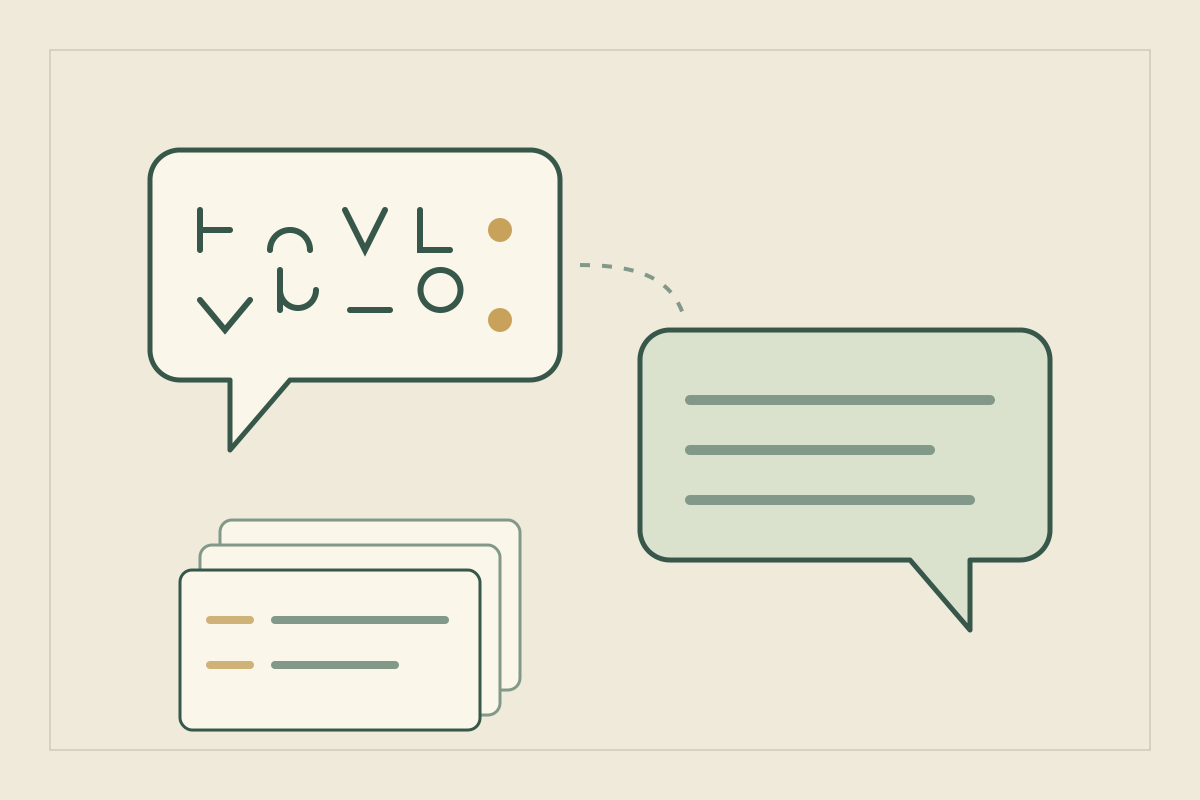
Most stories need a small, consistent set of words and phrases rather than a full grammar: a sound palette, a few rules for how phrases are built, and a lexicon recording each term’s meaning, speakers and first appearance. Translate most dialogue into the narration language. Leave untranslated only words that name something the reader’s language lacks, that the viewpoint character cannot understand, or whose sound matters, and make their meaning clear through context. A story about language itself, or a plot that turns on exact wording, needs more.
Your trader climbs to a mountain pass to buy wool from herders who speak another language. You want that language to feel real, but you have no wish to spend a year on verb tables, and the reader has no wish to decode every line. The real work is deciding how much to build and how to show it.
The examples follow an invented trading post at a high pass. Pell, a lowland trader’s son, speaks a little Osvari, the herders’ language. Ketti, a herder, is fluent in both languages, and her grandmother Ressa speaks only Osvari. Every Osvari word here is invented for the exercise. For building names from a small set of sounds, see naming places with a small language pattern; this guide starts where speech begins. The herders here are human. If the speakers are another species, decide what the mouth can say, what the ear can hear and what a lifespan can remember before you choose sounds. Creating a fantasy race is that step. Then bring back only the words this guide asks for.
Decide what the language does in your story#
How much language you need depends on its job, not on how ambitious the book is. As an editorial starting point:
| The language’s job | What to build | What reaches the page |
|---|---|---|
| Marks a border or a community | A sound palette and a handful of words | Greetings, forms of address, an oath |
| A barrier the viewpoint must cross | The phrases they hear often, and what they mishear | Untranslated lines that clear up over chapters |
| The plot turns on a meaning | The exact sentences involved, built from consistent rules | A mistranslation, a double meaning, a carefully worded vow |
| Language is the story’s subject | Grammar as well as vocabulary, worked out in depth | Enough that readers can follow the characters’ reasoning |
Osvari at the pass does the second and third jobs: Pell has to learn it, and a deal goes wrong over one word. The story needs the phrases Pell hears every day and one word defined carefully enough to cause trouble. It does not need the past tense of every verb. A story whose subject is language itself is a larger project than this guide covers.
Build phrases from a few rules#
You need enough grammar to stay consistent, not enough to be complete. Decide only what will show up in quoted lines:
- Word order. In Osvari, the verb comes last in a statement. Keep it there in every line you quote.
- Questions. A question adds the particle
kaafter the verb. - Respect. The suffix
-tumarks an elder or a stranger:Ressa-tu. - Shared roots.
oskuis fire andrennumeans burns or is lit. The everyday greetingOsku rennu ka?, “Is your fire lit?”, and its replyOsku rennu, “It is lit”, share parts readers start to recognize.
Build each new phrase from these rules rather than from fresh sounds. When a scene needs a sentence the rules cannot make, add one rule and write it down.
Choose what to translate#
Render most speech in the narration language#
When Pell understands what is said, or the scene is told from Ketti’s point of view, write the dialogue in the narration language and mark the switch once: “Ketti answered in Osvari.” After that, let the conversation run. Pages of invented words invite skimming, and readers skim past the meaning too.
Translated speech should sound fluent, because the speakers are fluent. Let the language show through idiom and imagery rather than broken grammar. Ressa might say “Your fire is low” where a lowlander would say “You look tired”. One translated idiom in a scene carries more flavor than ten untranslated words.
Keep untranslated only the words that carry weight#
Leave a word in Osvari when:
- it names something the narration language lacks, such as
vesh, the debt a guest owes for sharing a fire, which can be repaid in help or gifts but never in money; - the viewpoint character does not understand it, and the reader should share that gap;
- its sound matters, as with a greeting, a name or a ritual phrase.
Make meaning clear without a footnote#
Introduce a term through use, then let a reaction or result fix its meaning. When Pell offers silver for a night by the fire and Ketti flinches, the reader learns that vesh is not a price before anyone defines it. A short gloss in passing works once (“the vesh, the guest-debt”), not every time the word appears. Decide whether invented words are italicized, and apply the choice everywhere.
Give speakers register and dialect#
A language is not one voice. Ressa speaks careful Osvari with every respect form. Ketti drops -tu with friends and keeps it for her grandmother. Traders at the post use a clipped market Osvari, with few verbs and no suffixes, which herders find faintly rude. Pell learned the market version first, so his politeness slips without his knowing.
Register also shapes how bilingual characters speak the narration language. Ketti speaks it well but formally, because she learned it from contracts and trade disputes. Show that through word choice and rhythm, not respelled pronunciation. Phonetic accents are hard to read and slide easily into caricature, especially when they echo the way a real group’s speech has been mocked.
When a bilingual character switches languages, the switch says something. Ketti moves into Osvari to tell her grandmother something Pell should not hear, and back into the narration language to end an argument on her own terms. Choose those moments deliberately.
Follow one trade at the pass#
Pell has come up for winter wool, with silver and a sack of salt. Ressa will not talk about price until they have shared her fire. From Pell’s point of view, the scene might open:
Ressa did not look at the salt. “Osku rennu ka?” she asked, and Pell, who knew that one, answered, “Osku rennu,” and was pleased with himself until Ketti winced.
“Osku rennu, Ressa-tu,” Ketti said, not looking at him.
Three decisions sit in those lines. The greeting stays in Osvari because Pell knows it and its sound marks the meeting. The missing suffix is shown, not explained. Ketti’s correction tells the reader that a respect form exists, and that Pell has just failed to use it.
Then Ressa and Ketti discuss the price in Osvari. Pell cannot follow, so the narration gives only what he catches: vesh, his own name, a number. The reader shares his unease. Later he offers silver for the night’s shelter, turning a vesh into a sale, and the insult costs him the wool. That misunderstanding is why vesh needs a precise definition in your notes: what creates it, what settles it, and who can claim it.
Keep a lexicon as you write#
Whenever a word reaches the page, record it. A useful entry holds the spelling, meaning, literal sense, who uses it and how, and where it first appears:
| Term | Meaning | Literal sense | Who uses it, and how | First appears |
|---|---|---|---|---|
Osku rennu ka? | “How are you?” | “Is your fire lit?” | Everyone at the pass, every day | Chapter 1 |
-tu | Respect for elders and strangers | None | Herders, formally; traders rarely | Chapter 1 |
vesh | A guest’s debt for a shared fire, never paid in money | “Warmth owed” | Herders, seriously | Chapter 2 |
ruvel | Lowlander | “People below” | Herders, sometimes as a slight | Chapter 3 |
Check the lexicon before coining anything. A second word for fire when osku already exists is an easy way for a language to come apart. After each draft, search the manuscript for spelling variants of your most frequent terms.
Common language mistakes and fixes#
- A code for the narration language. Every word swaps one for one, idioms included. Give the language at least one distinction the narration language lacks, like
vesh, and idioms drawn from its speakers’ own lives. - Fluent speakers who sound broken. Ressa is eloquent in Osvari, so her translated speech should be too. Show second-language speech through register and word choice, not dropped articles.
- Drift.
veshin chapter 2 becomesveskin chapter 9, or slowly widens to mean any debt. Fix the spelling and meaning in the lexicon, then search for variants. - New names for ordinary things. Renaming bread and cups makes readers translate without learning anything; the culture guide explains when a coined word earns its place.
- Borrowed sounds as a costume. Imitating a real language’s sounds to signal “foreign” can turn its speakers into a caricature. Build from your own palette; if you draw on a real language, learn how its speakers actually use it.
Fit the language to point of view and length#
The viewpoint character’s fluency sets the reader’s. If Pell narrates, Osvari stays partly opaque and clears as he learns, which makes his progress visible on the page. If Ketti narrates, translate almost everything and keep only the words with no equivalent. With alternating viewpoints, the same conversation can be opaque in Pell’s chapter and fluent in Ketti’s, and the difference shows the distance between them. An omniscient narrator can translate freely, but leaving a word untranslated should still mean something.
Length changes the scale. A short story needs a handful of words, ideally one that matters to the plot. A novel needs a lexicon kept from the first draft. In a series, treat every word in print as fixed; a glossary at the back can help returning readers, though each scene should still make sense without it.
Keep the lexicon in Yazar.io#
Yazar.io has a Glossary section that fits this lexicon well. Set up its field template once, with text fields for the literal sense and first appearance, a choice field for register and a relationship field for the characters who use each term, and every new entry asks the same questions; changing the template later leaves existing entries as they were (updates). Mention Ressa in the entry for -tu and her name links itself, so her backlink panel lists every term tied to her (features).
If you later want a glossary at the back of the book, the Markdown export gives you a starting draft (features). A growing lexicon is no problem on the free plan: the Glossary is unlimited there, while sections such as Characters allow 15 editable records per book (pricing).
Update, 19 October 2026: Added a link to the guide on creating a fantasy race, for languages spoken by a people who are not human.
Sources
- Yazar.io: Features · October 10, 2026
- Yazar.io: Product updates · October 10, 2026
- Yazar.io: Pricing · October 10, 2026