The short answer
Create a fictional culture around a shared problem, then show how different people respond to it. Turn values into everyday practices with costs and exceptions. Give customs a history of change, and let members disagree; a culture becomes believable through those differences, not through a uniform list of traits.
A culture is not a checklist of foods, festivals, and clothing. Those details can be useful, but they become more convincing when they reveal how people make a life together, and where they disagree about it.
Start with an ordinary decision. Who gets the last water from the communal well? Who may refuse a guest? Who is expected to leave home, and who is expected to stay? The answers connect material circumstances with values and power.
Begin with a shared problem#
Choose a pressure that people must organize around: unreliable harvests, dangerous travel, limited living space, or a migration that divided families. The pressure does not determine a single inevitable culture. It creates a problem to which different groups can offer competing solutions.
A short wet season, a rain shadow or a pass that closes under snow is that kind of pressure. How to design a believable climate for a fantasy world is where you choose the pressure before the customs answer it.
The meal that comes out of that year is its own question. Creating believable food for a fantasy world builds the staple, the preserve and the rule about who may eat. This page stays with the society the meal belongs to.
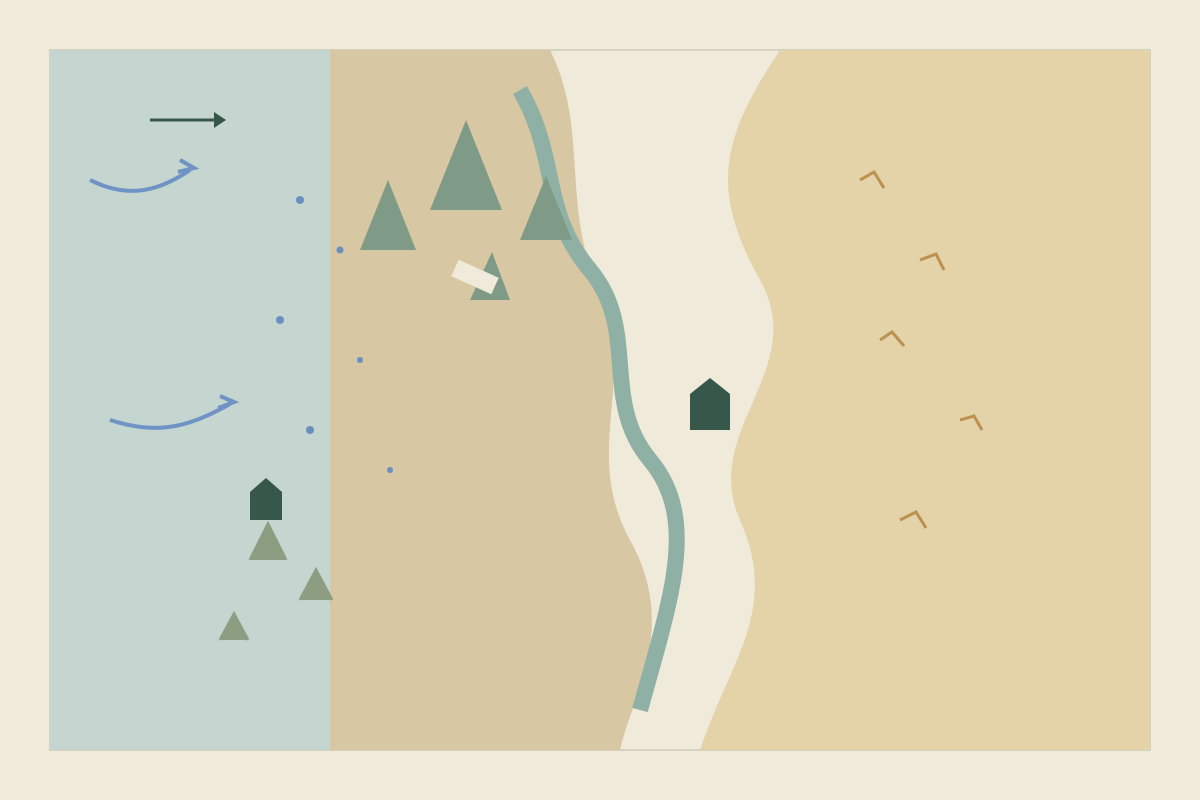
Imagine a settlement beside a river that changes its course every generation. One response is to build temporary houses. Another is to fund embankments. A third is to give abandoned land a sacred status. All three could coexist, and the argument between them is more interesting than a universal custom.
A body works the same way. A long life, gills or skin that needs salt water changes what a day can hold. It does not hand everyone the same personality. If you are inventing that body as well as the customs, start with creating a fantasy race.
Turn values into everyday decisions#
“Hospitality matters here” is an assertion. A household keeping a second cooking pot for unexpected visitors is evidence. A poor family resenting that obligation introduces tension.
For each value, describe a practice, its cost, and an exception. If elders deserve respect, what happens when an elder is wrong? If independence is admired, how do people care for someone who cannot work? Exceptions make a value feel lived rather than printed on a banner.
| Stated value | Everyday practice | Point of tension |
|---|---|---|
| Hospitality | Leave a place at the evening meal | A guest stays through a shortage |
| Continuity | Reuse names from earlier generations | A young adult chooses a new name |
| Stewardship | Repair tools in a shared workshop | A craftsperson refuses to share a discovery |
Build differences within the society#
Avoid giving every member the same belief. A port merchant, an inland farmer, and a child raised abroad may all belong to the same culture while disagreeing about its obligations.
Pick three people with different relationships to one custom. One benefits from it, one finds comfort in it, and one pays an unfair cost. Let each person explain the custom in their own words. You do not need to decide that only one explanation is legitimate.
Distinguish the rule from the reality#
A law, a religious teaching, and an everyday habit can point in different directions. A society may praise generosity while inheritance rules concentrate wealth. Characters may recognize the contradiction without possessing the power to resolve it.
Keep notes on both the ideal and the practice. This gives you a way to write institutions without making every individual their perfect representative.
Give customs a history of change#
A tradition may be old without being unchanged. A festival that once marked the safe crossing of a river could become a remembrance ceremony after a bridge is built. Merchants might then promote it as a market day. Some residents would welcome the change; others would consider it a loss.
For two or three important customs, record an earlier form, a recent change, and someone who wants a different future. You will gain a usable timeline without writing centuries of unrelated events.
Follow one custom through the river settlement#
To see the steps working together, return to the settlement beside the wandering river and develop its third response: abandoned land with a special status.
When the river takes a street, its families move to higher ground and the land they leave becomes “remembered ground”. Nobody may build there again. Each household sets a marker stone where its doorway stood. The stated value is that no one should profit from a neighbor’s loss: without the custom, anyone with savings could buy flooded plots cheaply once the water dropped.
The cost is space. Building land runs short, rents on the high ground climb, and young couples wait years for a plot. The exception creates leverage: the embankment council may build across remembered ground only if every marker family agrees, so one household can stall a wall the whole settlement needs.
Now give the custom three relationships:
| Person | Relationship to the custom | How they explain it |
|---|---|---|
| A landlord on the high ground | Benefits, because scarce land keeps rents high | “We do not grow rich on our neighbors’ grief.” |
| A woman whose family stone is among the oldest | Finds comfort in standing where her grandmother’s door was | “The river took the house, not the place.” |
| A young ferry worker renting one room | Pays the cost, because he cannot afford land of his own | “Stones have more land than I do.” |
None of them is lying. The landlord can believe every word while also profiting from it.
Then give the custom a history. In its earliest form the markers were reed bundles, renewed each year, and the ground reopened once nobody alive remembered living there. After the embankments slowed the river, the settlement stopped losing streets, the reopening rite fell out of use, and families replaced the reeds with stone. Now the ferry worker’s friends want the oldest ground reopened, the council wants its next wall built across it, and the woman with the old stone wants neither.
You now have a scene that needs no new invention: the river is rising, the newcomer needs a dry place to sleep, and the nearest empty floor is the shell of a house on remembered ground.
Borrow carefully from the real world#
When researching a real tradition, seek accounts from people within that tradition and distinguish regional, historical, and individual differences. Do not take a sacred practice, detach it from its meaning, and treat it as exotic decoration.
Combining several cultures is not automatically thoughtful. Ask whether you understand the function of each borrowed detail and whether a recognizable group is being reduced to a stereotype. Invented cultures can still reproduce real caricatures.
A practical alternative is to borrow a question rather than a visual marker: how do communities remember displacement, negotiate shared water, or care for the dead? Research can deepen the question without supplying a ready-made costume.
Match the depth to the story#
Build in proportion to the page time the culture gets. A workable rule: develop the custom the plot turns on, and sketch the rest until a scene needs it. The table is a starting point, not a quota.
| Story length | Develop fully | Leave sketched or open |
|---|---|---|
| Short story | One custom, its cost, and one disagreement | Deep history, other regions, most vocabulary |
| Novel | Two or three customs, three viewpoints, and the history behind the plot’s central custom | Institutions your characters never deal with |
| Series | Internal regions or factions, recurring terms, and how the culture changes between books | Anything a scene has not yet needed |
Choose who notices the culture#
Point of view decides what the reader can see. A local narrator rarely notices the norm; they notice breaches of it. The ferry worker would not describe marker stones as strange, but he would notice a stranger sitting on one.
An outsider notices the norm and often misreads it. A newcomer might take remembered ground for a graveyard. The error is useful: whoever corrects it, irritated or amused, shows you something about themselves. If you alternate viewpoints, give each one a blind spot.
Write a scene at the boundary#
Put a newcomer in a situation where two locals disagree about what should happen. Perhaps the newcomer asks for shelter, but the river is rising and the guest room holds the household’s grain.
Let the disagreement reveal the custom, the material constraint, and each person’s priorities. Avoid assigning one character the job of explaining the entire culture. A believable world often emerges from what people assume, negotiate, or refuse to say.
Keep the scene beside your reference notes. When a later rule contradicts what made the scene convincing, revise the rule, or make the contradiction part of the world. If magic shapes these institutions, pair this exercise with building a magic system.
Questions to test the scene#
Before you build further, check the draft:
- Could a reader infer the custom without anyone defining it?
- Does at least one character want something the custom forbids or makes expensive?
- Do the two locals disagree because of their circumstances, not only their temperaments?
- Does someone gain from the custom in a way they would not admit aloud?
If several answers are no, the scene probably needs a sharper material constraint, not more cultural detail.
Common mistakes and how to fix them#
A good culture and a bad culture. Antagonists often get a society that is cruel all the way through, and protagonists get one with only virtues. Give the hostile culture ordinary needs and internal dissent, and give the admired one a cost that someone resents. This matters most when an invented culture resembles a recognizable real group.
A dictionary on every page. Renaming ordinary objects makes readers translate without learning anything. Coin a word when the culture distinguishes something the reader’s language does not, and introduce it through use rather than definition. The same restraint helps when you name places in a fictional world. For how much of a language to show in dialogue, see inventing a fictional language.
Develop the community in Yazar.io#
Yazar.io works well for a culture, because a community spreads across several kinds of entries: the group itself in Organizations, its places in Locations, its own words in the Glossary, and the people who practise or resist its customs in Characters. Record the shared custom in the community’s entry and mention the two characters who interpret it differently (features).
Those mentions become links automatically, so each character’s backlink panel leads back to the custom when you write their disagreement. If the culture has terms the reader will meet in dialogue, a glossary entry keeps their spelling and meaning in one place. The aim stays the same: preserve specific viewpoints rather than reduce the culture to a checklist.
Update, 10 October 2026: Added a worked example, guidance on depth and point of view, scene test questions, and common mistakes, and expanded the Yazar.io section with specific features from Yazar.io’s public pages. On 8 October 2026, a topic-specific Yazar.io suggestion had been added. Update, 19 October 2026: Added a link to the guide on creating a fantasy race, for a people whose body is part of the culture. Update, 27 October 2026: Linked the guide on designing a believable climate, for a short wet season, a rain shadow or a pass closed by snow as a shared pressure. Update, 29 October 2026: Linked the guide on creating believable food, for the staple, the preserve and the rule about who may eat.
Sources
- Yazar.io: Description of the service · October 8, 2026
- Yazar.io: Features · October 10, 2026