The short answer
Start from a fiber the land can actually give: wool from a fleece, linen from flax, or silk only if someone reels it from a silkworm cocoon or carries it in. Let the weather pick the outer layer, let one job wear one spot thin, and give the dye a source that can run short. Until the 1850s almost all dyes were natural, and only about a dozen found wide use. Put one worn coat in a scene and let two people want the same length of colored cloth. The coast of Leth in the worked example is invented. Fiber and dye facts below are from archived Britannica articles, not from a textile you can buy.
Writers who want believable clothing usually want a coat that could have come from that land. A silk gown on a wet quay with no one to carry the silk, the same new cloak on the salter and the buyer, and a red that never runs short are three different mistakes. Each one is easier to avoid if you decide the fiber, the weather, the work and who may wear the color before you name the fashion.
This guide uses Earth as the reference for fibers and dyes, and it says so when a fact comes from a source. Britannica’s pages were read from archived copies, because the live pages did not open to an automated check on 2 November 2026. Your world can break a rule. The break should be a choice you can point to, the way a spell is. Nessa, Sera, Tav, Marr, Ors and the pass at Kelm are invented. They sit on the coast of Leth, so the wet side, the dry side and the closed pass are already a year you can use. If you have not set that year, how to design a believable climate is the page that does it. On that coast, grain and wool already move west while the pass is open. This page is about the coat that wool becomes.
Start from the fiber the land can make#
Wool is the fleece of sheep and of other hairy mammals, such as goats and camels. It is mainly taken by shearing the living animal. The fiber’s crimp and its spring let a cloth trap air, and that air holds heat. Wool can hold as much as 16 to 18 percent of its weight in moisture. As it takes moisture from the air it becomes warmer for the person wearing it. It is slow to feel damp, and it does not chill the wearer by drying too fast. Britannica, as archived on 21 September 2026, is the source for those properties. That is why a wool coat belongs on a rainy harbor. A fiber that cannot do this job does not, unless you have named a spell.
Wet wool does a second thing you can spend in a scene. When wet fibers are worked, they mat into a packed mass. Britannica calls that felting. A person who stamps wet cloth above a harbor, the fuller, is doing that job on purpose. The coat that comes off the step is thicker than the yarn that went in. It is also the coat the rain will meet.
Linen is yarn and cloth made from the flax plant. The fiber comes out of the stalks by retting, which is a fermentation, then drying, crushing and beating. Linen is stronger than cotton and dries more quickly. It wrinkles, because the fiber has little give. It takes up moisture and lets it go quickly, and it conducts heat, so linen clothes feel cool to the person in them. Britannica, as archived on 10 August 2026, records those points. A hot day can use a linen shirt. A snow month on a wet quay wants wool outside it. The shirt can still be linen. The coat should not be, unless you have said why the wearer is cold on purpose.
Silk, in commercial use, is almost entirely filament taken from the cocoons of domesticated silkworms, caterpillars of moths in the genus Bombyx. The craft began in China, and the caravan route later called the Silk Road carried the cloth west to Syria and on to Rome. Britannica, as archived on 9 October 2026, is the source. If nobody on this coast keeps the moth, a length of silk is a traded good. It arrives short, or it does not arrive. It is not a fleece you shear in the yard.
Write two lines before you invent a wardrobe:
- Raised or grown here: the wool from the herds east of Ors.
- Brought in, or absent: silk, and any fiber this coast does not give.
If the wool comes from a herd, the herd needs grass. Creatures that fit their ecosystem start from a habitat. A fleece with nothing the animal can eat will not clothe a harbor. The same coast already decides what people eat. Believable food follows the fish, the grain and the closed pass. The coat is the other thing that has to cross before the snow.
Let the weather choose the weight#
Climate does not hand a people a style. It hands them a year of what the outer layer has to do.
On the wet side, at Marr, the coat is wool because the fiber traps air and takes up moisture without chilling the wearer at once. On a day you have made hot, linen’s quick drying is the reason a shirt is linen. If the salter and the inland buyer wear the same weight in the snow month and at the harvest, the year is not in the clothes.
Calculating travel times turns the pass into days. Use it for one question. Can the wool still cross while the road is open, and does the coat on the far side still match the month it arrives in? A coat cut for the harbor rain is the wrong coat for a dry room in Ors, unless someone there is about to walk back into that rain.
Let the work wear one spot thin#
A garment shows the job. Sera salts fish. The elbow of her coat meets the rim of a barrel, then shines, then splits. The cuff takes salt. A coat with no thin spot is a coat nobody has worked in.
The city guide gives each ward a job you can walk. Designing a fantasy city starts from water, food and work. Here the work is enough if one motion, lifting a barrel or stamping wet wool, marks one place on the cloth. You do not need a second city to show that.
Decide who may wear the color#
Until the 1850s, virtually all dyes came from natural sources, mostly plants, with a few from insects, and only about a dozen natural dyes found wide use. Alizarin, a red, comes from the root of the madder plant. Indigo, a blue, comes in Europe from the woad plant and in Asia from the indigo plant. Wool takes dye readily: Britannica gives it a good to excellent affinity for dyestuffs. Natural dyes do not go directly onto cotton the way they go onto wool and silk. Cotton can still be dyed, by a vat or by a pretreatment with metal salts called mordants. Britannica, as archived on 17 October 2026, and the wool page archived in September 2026, are the sources. A red wool coat and a red cotton shirt are not the same day’s work.
Scarcity is the part a scene can use. A 1909 trial of the shell purple called Tyrian purple yielded 1.4 grams from 12,000 snails. You do not need that snail. You need one color that can run short. Madder red from a plot behind Ors is enough. The person who tends the vat, the person who wears the coat in the rain, and the person who pays are not the same person.
The rule in the worked example is invented. Do not lift a living tradition’s sacred color, or a real garment that a faith restricts, and use it as decoration. Invent the limit, or study a real one in its own accounts and keep the argument inside it. Creating a fictional culture starts from a shared problem and from people who answer it differently. Dress is one practice inside that problem. A fictional economy follows the thing that runs short. Here that thing may be the root, the dyer’s labor, or a place on the last cart.
Put the coat in a scene#
A reader learns the clothing from what is worn through and from what someone wants that is not on the coat. Revealing lore without an info-dump gives each fact a job in the scene. The job here is an argument over one length of red, not a tour of the chest.
A list you can use tonight#
- Name the fiber this land can raise or grow, and one it cannot.
- Name the weather that outer layer is for.
- Name the work that wears one spot thin.
- Name the dye, where it comes from, and the month it runs short.
- Name who may wear the color, and one person who wants it anyway.
- Write one scene: one coat, one worn place, and two people who want the same length of cloth.
- Stop when a scene can use what you have.
Walk one coat through Marr#
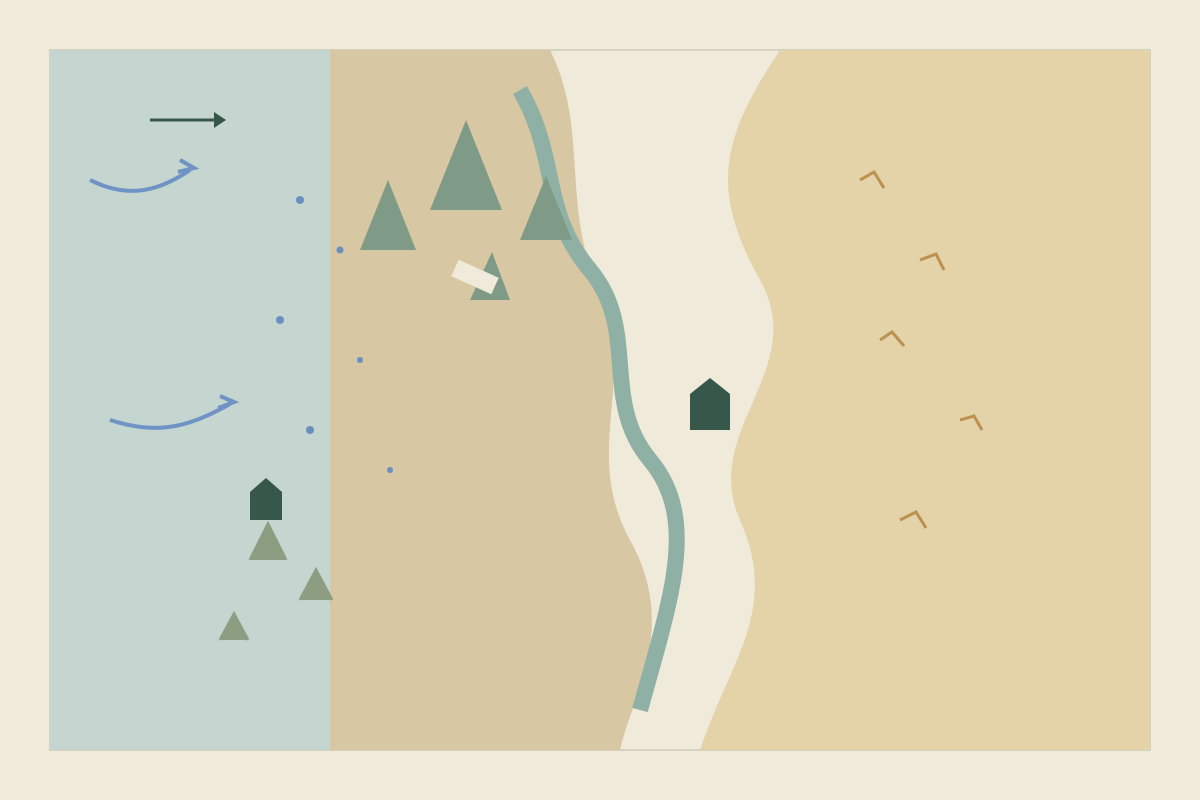
Leth sits near 50 degrees north, on a wet west coast, with the Kelm pass between the harbor of Marr and the drier city of Ors. Herds east of Ors grow the wool. While the pass is open the wool moves west. In the snow months the pass is shut, and a new fleece does not arrive.
Nessa fulls wool above the harbor. Fulling here means working the wet cloth so the fibers mat, which is the felting Britannica describes. When the root runs short, she can still full a coat. She cannot put the red on it.
The invented rule is small. The first length of madder red from the vat goes onto a working coat in Marr. It is not sold onward. Sera salts fish in a coat whose elbow has already split and whose cuff is crusted with salt. She wants that red on the coat she is already wearing, because she is the one the rain hits. Tav buys for a household in Ors. He wants the same length in the cart, because the pass closes and his household will see no new dyed cloth until the snow goes. He can pay for a fulled coat. The red is the part the rule keeps in Marr.
The scene does not need a speech. Tav presses the new cloth and asks whether the red is in the bundle. Nessa nods at Sera’s coat, where the opening is still the color of the wool. Sera is already wearing the split elbow out into the rain. Nessa is paid for the fulled cloth, not for the red. She can see which choice leaves her short of root and of pay.
| Person | What they want from the cloth | What the coat shows |
|---|---|---|
| Nessa, at the fulling step | A coat she can sell, and root enough for the red | Red on her hands, and one length still in the vat |
| Sera, at the salt house | That red on the coat she works in | A split elbow, salt on the cuff, no red yet |
| Tav, buying for Ors | That length in the cart before the pass shuts | At home, a coat that has not met this rain |
In the snow months the vat still works if any root remains, but the new wool is on the far side of a closed pass. Sera’s coat is the same coat, more split. Tav’s household wears last year’s cloth. If you write both of them in a new red coat, you have skipped the closed pass and the rule.
Check the scene before you add a second wardrobe:
- Can a reader tell that the coat is wool, and that the wool had to cross the pass?
- Does one spot show the work?
- Do two people want the same length of red?
- If the story moves into the snow months, is the new wool gone from Marr?
If the last answer is no, the season is decoration. Close the pass, or write the reason the fleece is still arriving.
Mistakes that make clothing look pasted on#
The silk with no road. A gown of cocoon filament on a coast where nobody keeps the moth and nobody carries the cloth. Give the silk a caravan, a ship, or a spell, or dress the scene in wool.
The same new coat on every back. The salter and the buyer are both spotless in the snow month. Give one coat the split elbow and the other a coat that never met the rain.
Linen as the snow coat. Linen feels cool and dries quickly. It can be the shirt. It is the wrong outer layer for the wet snow month unless you have said why the wearer chose to be cold.
The lecture. Nessa explains keratin and water uptake to a buyer who only needs to know whether the red is in the bundle. She would not. Let the split elbow and the vat carry it.
The sacred color as costume. A real restricted dye or a real ritual garment, copied for its look and stripped of the argument inside it. Invent the limit, or keep the real one whole.
The dye that never runs short. If madder is free and endless, the red length does nothing. Give the root a plot, a price, or a month when the vat is brown.
Cotton that drinks dye like wool. Natural dyes do not go straight onto cotton. If the shirt is cotton, give the dyer the vat or the mordant, or change the fiber.
The coat that never wears. Every elbow is new. Put one job on one spot, or the clothes are a sketch beside the scene.
Keep the coat next to the people who wear it#
When the same coat, harbor and red show up in more than one scene, keep them where a mention can find them. Yazar.io holds locations, items, lore and beliefs in one book (features). Marr can be a location, the coat and the madder an item each, and the rule about the first red length a belief. Type the name of the coat in the city’s text and it links itself. You can also type @ and pick the record. Each page has a backlink panel of the pages that mention it (features).
Field templates let you add the questions this coat actually uses, such as the fiber and who may wear the color, with field types that include text, choice and relationship. Changing a template later does not change the records you have already written (updates). An item can hold several images, and the first one is the main image on the card (updates). A sketch of the split elbow can sit on the coat’s record. It does not write the scene.
The free plan includes 15 editable records for each entity type in a book. Items is one of those types, so a coat, a length of wool and the dye fit. A list of every cut in the market is a larger set of item records than these. Glossary, Timeline, Notes and Quotes are unlimited on that plan for ordinary individual writing, so a garment you have not settled can stay a note. The pricing page is where any higher limit is listed. The manuscript stays in Word or Google Docs. Yazar.io keeps the records and does not write the scene (features).
Sources
- Encyclopaedia Britannica: Wool (archived 21 September 2026) · November 2, 2026
- Encyclopaedia Britannica: Linen (archived 10 August 2026) · November 2, 2026
- Encyclopaedia Britannica: Silk (archived 9 October 2026) · November 2, 2026
- Encyclopaedia Britannica: Dye (archived 17 October 2026) · November 2, 2026
- Yazar.io: Features · November 2, 2026
- Yazar.io: Pricing · November 2, 2026
- Yazar.io: Product updates · November 2, 2026