The short answer
Start a dynasty’s family tree with its succession and inheritance rules, then add only the people whose claims, marriages or exclusions the story needs. Decide who rules on a marriage, a birth or an adoption, and leave at least one point the rules do not settle cleanly, because that is where rival claims come from. Record births, marriages, deaths and successions in one calendar, and recheck every age at each key event whenever you move a date.
A family tree drawn as decoration gives you names joined by lines. A family tree drawn around a succession rule gives you people with reasons to marry each other, disown each other, or wish each other dead. The difference lies in the order of decisions: the rules first, then the people those rules turn into claimants.
The example follows House Tarne, an invented family that holds the lordship of a walled city called Esk. Years are counted in the city’s own reckoning. Nothing here describes a real dynasty.
Choose the succession rule first#
Before naming anyone, decide how the title passes when its holder dies. Real dynasties have used many patterns, among them inheritance by the eldest child, preference for sons, an heir named by the holder, and election from among eligible relatives. Pick one for your house, then look for the place where it leaves room for argument. That gap is where your plot lives.
| Rule | Who inherits | The argument it invites |
|---|---|---|
| Eldest child | The holder’s first-born | Whether a birth or a marriage was valid |
| Sons first | The eldest son, then daughters | Claims through daughters and their husbands |
| Named heir | Whoever the holder chooses from the family | Who witnessed the naming, and whether it changed |
| Family election | A council picks among eligible relatives | Who sits on the council, and what each vote costs |
House Tarne uses the first rule, written into the city charter: the lordship passes to “the eldest lawful child of the house”. Two parts of that phrase are unsettled. Nobody agrees whether “lawful” requires a marriage the temple recognized, or whether “child of the house” includes a child adopted by formal act.
Then decide who settles a dispute. In Esk the temple rules on marriages and the guild council confirms each new lord. Two institutions with different interests give every claimant two doors to knock on.
Separate the title from the property#
Whoever inherits the seat need not inherit everything. Decide separately what happens to land, money, offices and personal goods. Splitting them gives losing claimants something to fight with.
In Esk the lordship goes to one heir, but private property follows the holder’s will. Aldric Tarne left the city mills to Bram, his son born outside marriage. Bram can never hold the title, yet he now controls the city’s flour, and any claimant who wants the seat needs his goodwill.
Decide what a surviving spouse keeps, too. A widow with her own lands and a grown son is a power in the city whether or not she ever claims anything herself.
Draw the living claimants, then their parents#
Start with the people alive when the story needs the tree, usually the moment the title is in question. Add the parents and marriages that explain each claim. Stop when another generation would not change anyone’s argument. Most novels need the present generation and two above it.
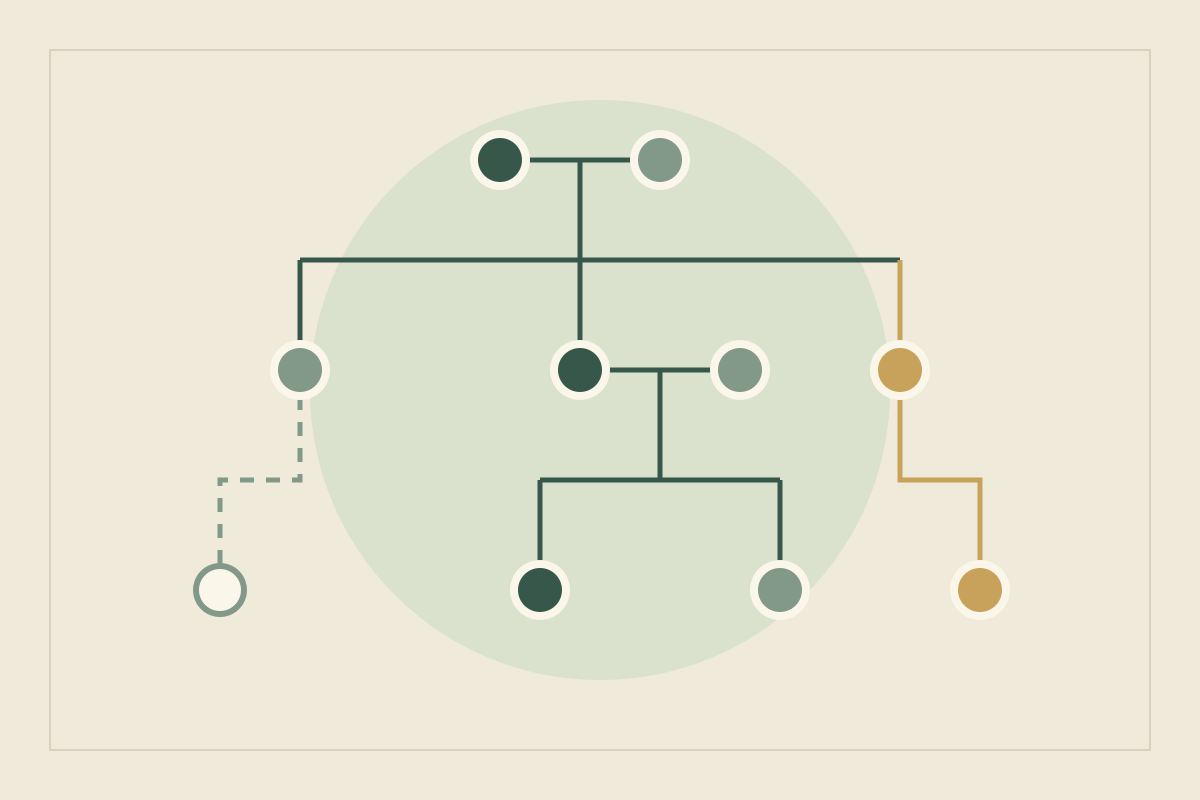
House Tarne when Aldric dies in 309:
- Aldric Tarne (241–309), lord of Esk.
- Ilse Varrow, his first wife, married 262, died 270. Their daughter Maud was born in 264.
- Corisande, his second wife, born 256, married 274. Their son Edric was born in 276.
- Bram, born 261 to a miller’s daughter before Aldric’s first marriage, raised in the household.
- Wren, born 287, the orphaned child of an ally, adopted by formal act in 290.
- Osric (244–298), Aldric’s younger brother and founder of the eastern branch. His grandson Piers was born in 285.
Nine names across three generations. Six of them outlive Aldric, and each has a stake.
Give each marriage a price#
A dynastic marriage joins two families, their debts and their soldiers. For each one, record what each side gained, what was promised, and who now backs the children. Maud’s mother was a Varrow, and the Varrows hold the river forts. Edric’s mother, Corisande, is alive and related to half the guild council. Half-siblings with different maternal families behind them are often a stronger engine than any personal rivalry.
Decide who counts as family#
Legitimacy and adoption are rulings, made by someone with the authority to make them. Rulings can be challenged, reversed or kept quiet. For each person at the edge of the tree, decide who made the ruling, who knows the full story, and what would overturn it.
Aldric married Ilse in 262, a year in which the temple had suspended all marriages in Esk during a quarrel with the lord. The temple recognized the marriage afterwards; Edric’s supporters now say the recognition was bought. If that argument wins, Maud is no more lawful than Bram.
Wren’s adoption act calls her “child of the house”, the charter’s own words. Nobody expected the phrase to matter when the act was drawn up, which is how a ward becomes a claimant.
Mark every relationship in your private notes as public, disputed or secret. Bram’s parentage is public. Ilse’s marriage is disputed. If you decide that one birth is not what the family claims, mark it secret and list everyone who knows.
Line up the rival claims#
A cadet branch, descended from a younger sibling, waits for the main line to fail or to split. Give it a grievance as well as a claim: lost land, a refused marriage, an old insult. Osric received the eastern estates instead of a share of the city, and his line has said for forty years that he was cheated.
With the rules and rulings in place, the crisis at Aldric’s death in 309 lays itself out:
| Claimant | Argument | Weakness | Backers |
|---|---|---|---|
| Maud, 45 | Eldest child of a recognized marriage | The wedding fell during the suspension | The Varrows and their forts |
| Edric, 33 | Born of an undisputed marriage | Younger, and his mother’s faction is resented | Corisande and much of the guild council |
| Wren, 22 | Her adoption act uses the charter’s words | Few believe the charter meant her | Anyone who wants a lord they can steer |
| Piers, 24 | A Tarne untouched by either mother’s faction | The main line still has living children | The eastern estates, and anyone tired of both factions |
Bram appears in no row and may matter most. Whoever he favors can feed the city through a hard winter; whoever he refuses cannot.
Check every age against one calendar#
Dynasty errors are usually arithmetic. Put every birth, marriage, death and succession in one calendar, then work out ages at each event the story uses. The guide to building a fictional timeline covers tracking events and what each character knows. For a family tree, add these checks:
- Parents’ ages at each birth. A very young or very old parent needs a reason in the story.
- The heir’s age at the succession. A child heir needs a regent, and the regent becomes a character.
- Gaps between siblings, especially half-siblings from different marriages.
- Memory. Anyone who recalls an event must have been old enough to remember it.
In 309, Aldric dies at 68. Maud is 45, Bram 48, Edric 33, Piers 24 and Wren 22. Corisande married at 18 and bore Edric at 20. Nothing breaks. Had Aldric died in 285, though, Edric would have been nine, and the story would need a regent, probably his mother.
What moves when one date moves#
Suppose a later chapter needs the temple’s suspension in 265, so you move the wedding there too. Maud, born in 264, now arrives a year before her parents married. Whether a later marriage makes an earlier child lawful is a rule you have not decided. Decide it now. If it does not, Maud has no claim and the crisis loses its eldest claimant; if it does, her claim rests on two disputed rulings instead of one. One moved date has changed the crisis, so make the change on purpose and walk every row of the claims table again.
Common mistakes and how to fix them#
The rules bend when the plot needs them#
A charter clause nobody mentioned appears in the last act and settles the succession. Put the ambiguity on the page early, in an argument that does not matter yet, so the reader recognizes it when it finally does.
Names blur across generations#
Families reuse names, and House Tarne’s “-ric” names are a deliberate habit. Aldric and Edric on the same page will still blur. Give one a byname, such as “the old lord” in Edric’s chapters, and keep repeated names to the people the plot needs.
Deaths that only clear the path#
Heirs who die conveniently make the tree feel rigged. Let each death create a new problem: a regency, a widow’s lands, an alliance with no one left to marry.
Scale the tree to length and point of view#
As an editorial starting point:
| Story shape | Draw in full | Keep in outline |
|---|---|---|
| Short story | The holder, two claimants and the one rule they dispute | Earlier generations and cadet branches |
| Novel | Three generations, every marriage that backs a claim, and one rival branch | Distant cousins and the branch’s internal quarrels |
| Series | The tree as it stands at the start of each book, with planned births and deaths | Generations no book visits |
Point of view decides which tree the reader sees. Maud’s chapters call Ilse “my mother”; Edric’s call her “the first wife”. A servant who witnessed the wedding may know more than either claimant.
If you print a family tree for readers, print the public version, the tree the city believes. Keep disputed and secret links in your private version until the story reveals them, or the appendix spoils the plot.
Draw the dynasty in Yazar.io#
The family tree in Yazar.io is a genuinely strong fit for this work. You draw generations of a dynasty with drag-and-drop and can reconnect any branch later, which a revision needs when a ruling moves Wren or Bram toward the main line (features). Relationships are mother, father, child, spouse and sibling, so record adoption acts and disputed marriages in the character entries. Mention House Tarne in each member’s entry and it links itself to the house’s page in Organizations, whose backlink panel then lists the family. The tree is included on the free plan (pricing).
For the age check, add births, deaths and successions to the timeline and link each event to the characters involved; each character’s page then lists those events in timeline order (updates). Dates are free text, such as “Year 309”, so the age arithmetic stays with you. If you share the world as a read-only wiki, you can publish the family tree or keep it off. Notes are never included, and the Timeline is off unless you turn it on (wiki, updates).
Update, 21 October 2026: Kept age arithmetic with the writer, and corrected the wiki so notes stay out while the Timeline can be published and is off by default.
Sources
- Yazar.io: Features · October 10, 2026
- Yazar.io: Product updates · October 10, 2026
- Yazar.io: Shareable wiki · October 10, 2026
- Yazar.io: Plans and limits · October 10, 2026