The short answer
Build a fictional timeline around the story’s present. Record each relevant event, its consequences, and who knows about it. Separate actual events from public accounts, mark uncertain dates explicitly, and check travel, ages, and dependencies whenever you move an event.
A bridge burns before the harvest, but a later chapter sends a cart across it the next morning. A useful timeline catches that kind of mistake. It need not begin with the creation of the universe. Start with the period your characters depend on, then expand when an earlier cause matters.
This method is an editorial planning exercise. The town, dates, and events below are invented examples, not historical claims.
Anchor the story’s present#
Choose an event as day zero: the protagonist arrives at the river town. You can add a calendar later. The guide to making a fantasy calendar the story can use shows how to keep that calendar small enough to check ages, seasons and named days. Relative dates such as “three days before arrival” are enough to check sequence without first inventing months and leap years.
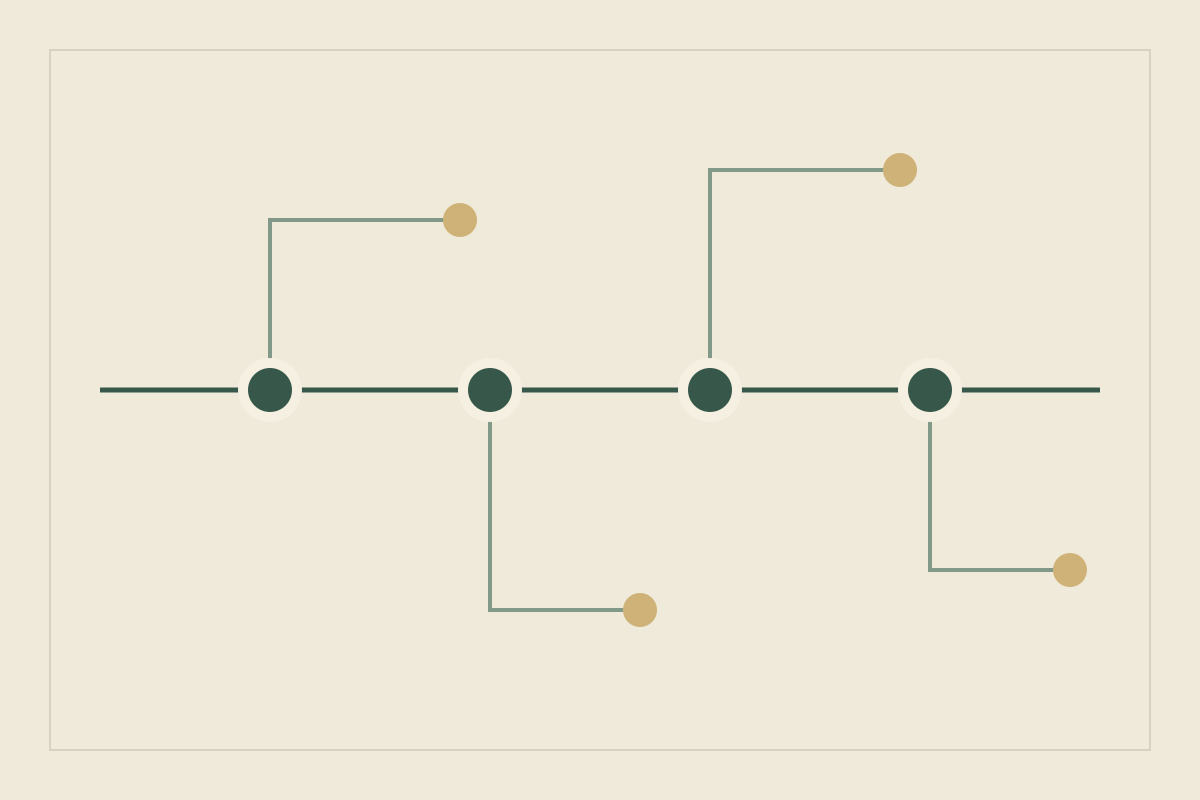
Record the bridge fire on day minus two, the first ferry on day minus one, and the council meeting on day one. These entries already explain why the protagonist arrives by boat and why residents disagree about a temporary crossing.
Give every event a consequence#
An entry should do more than state that something happened. Give it a cause or predecessor, an immediate consequence, and any later scene that relies on it. For the fire, record “bridge unavailable” and link the planned cart journey that now needs revision.
Do not claim an exact duration merely because the spreadsheet accepts a number. If rebuilding is not yet decided, mark the interval as an author decision still open. Keep that uncertainty in private planning notes until the story requires an answer.
| Relative date | Event | Consequence to track |
|---|---|---|
| Day −2 | Bridge burns | Carts cannot use the crossing |
| Day −1 | Ferry service starts | Boat capacity constrains arrivals |
| Day 0 | Protagonist arrives | Sees the ferry, not the fire |
| Day 1 | Council meets | Repair proposal becomes public |
Keep events separate from knowledge#
The protagonist cannot describe the fire as an eyewitness if they arrived afterward. Create a second field for the source of their knowledge: a witness, a rumor, a document, or an inference.
Public accounts can disagree with your author timeline. That is useful when intentional. Label the difference so a mistaken inscription does not silently become the canonical date in another chapter. Also distinguish when a message was sent from when each person received it.
Check dependencies after moving a date#
Moving the fire by a week can affect travel, supplies, character whereabouts, and the council’s response. Follow those connections before polishing the date labels. Use the region map to check which routes remain available; choose fictional travel assumptions explicitly rather than treating map distance as a complete travel estimate. Calculating travel times in a fantasy world is one way to set those assumptions. When births, marriages and successions must agree with each other, use the same checks on a dynasty’s family tree.
If age matters, record the character’s birth relative to the same calendar and check it at the scene date. If it does not matter, an approximate age may be more useful than unnecessary precision.
Follow the fire into the arrival and council scenes#
Trace the fire through four invented residents: when each learned of it, from whom, and what they now believe.
| Character | Learns of the fire | Source | Believes |
|---|---|---|---|
| Ferry keeper | Night of day −2 | Watched it from the bank | The bridge cannot be saved |
| Councillor | Day −1 | The bridge warden’s report | Someone set the fire |
| Carter | Day −1 | Talk at the market | Only the railings burned |
| Protagonist | Day 0 | The ferry keeper, during the crossing | Whatever the ferry keeper chooses to say |
The arrival scene now has a clear limit: everything the protagonist knows comes from one witness with an opinion. If the ferry keeper profits from the closure, their account can be vivid about the flames and gloomy about repairs.
The council scene gets its friction from the same rows. The carter wants a quick repair because he thinks the damage is slight; the councillor holds a report that points to arson. They learned different things on different days.
What breaks if the fire moves a week earlier#
Suppose a revision puts the fire on day −9. Walk the same rows first:
- The ferry has run for a week, so the arrival scene should show a routine and a fare, not improvisation.
- The carter has had time to see the bridge. Correct his belief or explain why he stayed away.
- The council waited a week to meet. Give the delay a cause, such as a quarrel over who pays.
- Any mention of smoke on arrival day is now wrong, and the cart journey planned for the morning after the fire moves too.
Fit the timeline to scale and point of view#
How much you track depends on the story’s length and on whose perspective the reader shares. As an editorial rule of thumb:
| Story shape | Track closely | Keep rough |
|---|---|---|
| Short story | Days or hours, and who is where | Calendars, ages, distant history |
| Novel, one viewpoint | When that character learns each event | What minor characters know |
| Novel, several viewpoints | Each viewpoint’s knowledge, and locations on shared days | Events no viewpoint character can learn about |
| Series | What earlier books have put on the page | Events you have not committed to |
In close first or third person, the narrator can report only what they saw, heard or inferred by that day. An omniscient narrator can reveal the arson before the councillor does, and the council scene then becomes dramatic irony instead of a mystery. Choose the effect before you draft.
If chapters jump back in time, keep the reading order beside the chronological order. A flashback to the fire placed after the council scene still happened on day −2.
Common timeline mistakes and how to fix them#
- One character in two places. With several viewpoints, the carter is at the market in one thread and on the road in another that day. List who is where on every shared date.
- Seasons that drift. The fire happens before the harvest, yet a scene days later describes bare stubble. Note the season on entries where crops or weather matter.
- Memories that contradict the scene. A character recalls the fire chapters later with different details. Check the original entry and decide whether the gap is a slip or a deliberate trait.
Keep the working view short#
Maintain a view containing only events that affect the current chapter. Leave deeper history in linked notes. A connected notebook can hold both without making every writing session a tour of the entire archive.
The test is simple: after changing one event, can you find the scenes, statements, and decisions that depend on it? If not, improve those links before adding another century.
Plan the sequence in Yazar.io#
The timeline in Yazar.io suits this method. Each event takes a date written in your world’s own terms, such as “Third Age, 114”, so you are not tied to a real calendar, and you can drag events into a new order when the story changes. Events can be linked to the characters who take part and the locations where they happen; those character and location pages then list their events in timeline order (updates).
Add the bridge fire, link the people who witness it, and use the event note to record when each of them learns about it. After you move the fire, open each witness’s page: the events appear in their new order and show what that person should know in the arrival and council scenes. Date labels are text you write, and nothing flags a contradiction for you, so checking each scene against the sequence is still your job.
Update, 26 October 2026: Linked the guide on calculating travel times, as one way to set the travel assumptions a timeline needs. Update, 21 October 2026: Described Yazar.io date labels as text you write, so the scene check stays your job. Update, 17 October 2026: Linked the guide to making a fantasy calendar the story can use, where this method defers inventing months and leap years. Update, 10 October 2026: Added a worked example following the bridge fire, guidance on scale and point of view, and common mistakes, and expanded the Yazar.io section with specific features from Yazar.io’s public pages. On 8 October 2026, a topic-specific Yazar.io suggestion had been added.
Sources
- Yazar.io: Description of the service · October 8, 2026
- Yazar.io: Product updates · October 10, 2026